
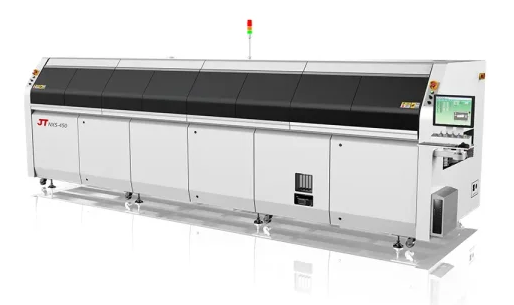
PCB Oven for Energy-Efficient and Flexible Lead-Free Processing
The PCB Oven is designed for flexible and reliable lead-free processing, featuring independent air velocity control for each section. This allows processing parameters to be adjusted according to different and complex PCB requirements while improving overall thermal process stability.
Its advanced cooling and air management systems help reduce thermal loss, improve flux reclamation, and lower electrical power consumption. Multi-layer, thicker thermal insulation keeps the oven surface temperature lower, while the optimized chamber design extends maintenance intervals. Additionally, 95% of the reflow oven materials can be recycled, supporting more sustainable manufacturing.
RS-600III Reflow Oven Specifications
Detailed specifications of the RS-600III / RS-600III-N reflow oven for reliable, flexible and energy-efficient PCB processing.
| Model | RS-600III / RS-600III-N |
|---|---|
| Outside Dimension (L × W × H) | 4190 × 1430 × 1530 mm |
| Weight | Approx. 1850 kg / 1950 kg |
| Number of Heating Zones | Top 6 / Bottom 6 |
| Length of Heating Zones | 2295 mm |
| Number of Cooling Zones | Top 1 / Bottom 1 (Cool Air Conversion) |
| Exhaust Volume | 10 m³/min × 2 Exhausts |
| Electric Supply Required |
3 Phase, 380V 50/60Hz Optional: 3 Phase, 400V/480V 50/60Hz |
| Electric Power Required | 48 KW / 51 KW |
| Power for Warm Up | 24 KW / 26 KW |
| Power Consumption | 6.5 KW / 7 KW |
| Warming Time | Approx. 20 Minutes |
| Temperature Setting Range | Room Temperature – 300°C |
| Temperature Control Method | PID Closed Loop Control + SSR Driving |
| Temperature Control Precision | ±1.0°C |
| Temperature Deviation on PCB | ±1.5°C (By JT Board Test Standard) |
| Commutated Element | Aluminium Alloy Plate |
| Data Storage | Various Parameters and Status are Storable (80 GB) |
| Abnormal Alarm | Abnormal Temperature (Extra-High / Extra-Low Temperature) |
| Board Dropped Alarm | Tower Light: Yellow – Warming; Green – Normal; Red – Abnormal |
| Rail Structure |
Subsection Integrated Type
Option: Subsection Separate Control |
| Max. Width of PCB | 400 mm (Option: 460 mm) |
| Rail Width / Adjustment Range | 50–400 mm / Motorized |
| Components Clearance | PCB Top 30 mm / Bottom 25 mm |
| Conveyor Direction |
L → R
Option: R → L |
| Fixed Rail Side |
Front Rail Fixed
Option: Rear Rail Fixed |
| PCB Transmission Agent |
Air-Reflow: Chain + Mesh
N₂-Reflow: Chain Only, Mesh Optional |
| Conveyor Height | 900 ± 20 mm |
| Conveyor Speed Range | 300–2000 mm/min |
| Lubrication Auto-Afflux | Standard |
| Cooling Method | Standard: Forced-Air Type |
Key Features of RS-600III Reflow Oven
Designed for flexible lead-free PCB processing with precise thermal control, efficient cooling and convenient operation.
12 Heating Zones
Six top and six bottom heating zones provide controlled and consistent thermal processing.
Efficient Cooling System
Top and bottom cooling zones with forced-air cooling support controlled PCB cooling after reflow.
Precise Temperature Control
PID closed-loop control with SSR driving provides accurate and stable thermal management.
Independent Air Velocity Control
Section-based air velocity control allows flexible adjustment for different lead-free PCB processes.
Motorized Rail Adjustment
Motorized rail adjustment from 50 to 400 mm provides convenient setup for different PCB widths.
Adjustable Conveyor Speed
Conveyor speed can be adjusted from 300 to 2000 mm/min according to process requirements.
Energy-Efficient Air Management
Advanced air management helps reduce thermal loss, electrical consumption and carbon output.
Improved Flux Reclamation
Optimized cooling and filtered or reclaimed air circulation support improved flux reclamation.
80 GB Data Storage
Various process parameters and machine status information can be stored for convenient production monitoring.
Temperature & Board Alarm
Temperature and board-drop alarm functions provide clear visual indication of machine status.
Flexible Conveyor System
Chain and mesh transmission options support both air-reflow and N₂-reflow applications.
Low Maintenance Design
Optimized chamber design and automatic lubrication support reliable operation and longer maintenance periods.