
TRV Series Vacuum Assisted Reflow Oven
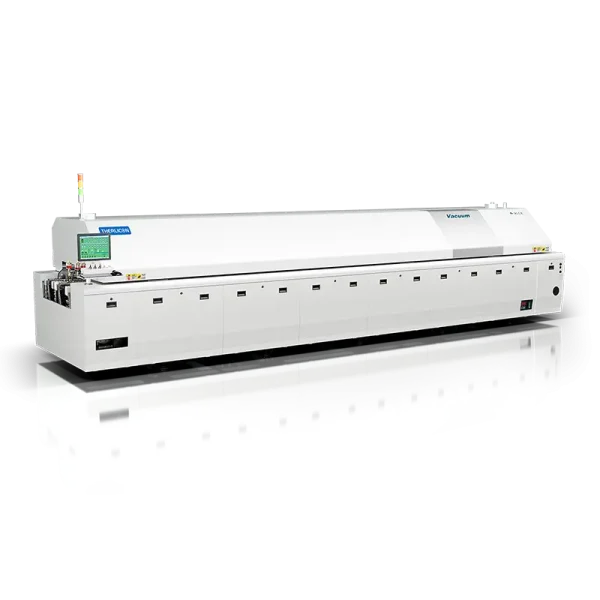
TRV Series Vacuum Assisted Reflow Oven for High-Precision Void-Free Soldering
The TRV Series Vacuum Assisted Reflow Oven is designed for high-efficiency SMT soldering where minimizing bubbles and voids is critical. Its independently controlled temperature zones allow precise adjustment of different temperature profiles, while the integrated vacuum system can achieve less than 1% void area under vacuum pressure down to 10⁻⁵ mbar.
The oven features a three-section conveyor system comprising heating, vacuum, and cooling zones, each adjustable independently for optimized production flow. With an average cycle time of 40–60 seconds, high-efficiency vacuum pumping, infrared heating in the vacuum unit, and an efficient flux collection system, the TRV Series delivers high throughput with low maintenance requirements and accurate vacuum and temperature control.
TRV-800-N Vacuum Reflow Oven Specifications
Detailed specifications of the TRV-800-N vacuum assisted reflow oven for precise, reliable and high-throughput SMT soldering.
| Model No. | TRV-800-N |
|---|---|
| Outside Dimension (L × W × H) | 5520 × 1430 × 1530 mm |
| Standard Color | Computer Grey |
| Weight | Approx. 2500 kg |
| Number of Heating Zones | Top 8 (1 IR) / Bottom 7 |
| Length of Heating Zones | 3110 mm (With Vacuum Area) |
| Number of Cooling Zones | Top 3 / Bottom 3 (Cool Air Conversion) |
| Exhaust Volume | 10 m³/min × 2 Exhausts |
| Electric Supply Required |
3 Phase, 380V 50/60Hz Optional: 3 Phase, 220V 50/60Hz |
| Electric Power Required | 67 KW |
| Power for Warm Up | 32 KW |
| Power Consumption | 10 KW |
| Vacuum Level | 5 mbar – 10 mbar |
| Warming Time | Approx. 25 Minutes |
| Temperature Setting Range | Room Temperature – 300°C |
| Temperature Control Method | PID Closed Loop Control + SSR Driving |
| Temperature Control Precision | ±1.0°C |
| Temperature Deviation on PCB | ±1.5°C (By JT Board Test Standard) |
| Heating Element | Special Heating Elements for Long Life |
| Commutated Element | Aluminium Alloy Plate |
| Data Storage | Process Data and Status Storage |
| Abnormal Alarm | Abnormal Temperature (Extra-High / Extra-Low Temperature) |
| Board Dropped Alarm | Tower Light: Yellow – Warming; Green – Normal; Red – Abnormal |
| Conveyor | Chain Conveyor |
| Rail Structure | Subsection Integrated Type |
| PCB Width Range |
Single Lane: Min. 70 mm – Max. 430 mm Dual Lane: Min. 70 mm – Max. 250 mm |
| PCB Length Range | Min. 150 mm – Max. 300 mm |
| Chiller | Standard |
| Flux Collection System | Standard |
| N₂ Control Device | Standard |
| Oxygen Analyser | Standard |
Key Features of TRV-800-N Vacuum Reflow Oven
Engineered for precise vacuum soldering, low void formation, stable thermal performance and high-throughput SMT production.
Vacuum Assisted Reflow
Integrated vacuum processing helps reduce bubbles and voids during the reflow soldering process.
Independent Temperature Control
Each temperature zone can be adjusted independently for precise and flexible thermal profiles.
Low Void Soldering
Vacuum technology is designed to achieve a void area of less than 1% under optimized conditions.
High-Efficiency Vacuum Unit
High-efficiency vacuum equipment supports rapid vacuum operation and optimized production cycles.
Three-Section Conveyor
Heating, vacuum and cooling sections provide individually adjustable process control.
High Production Throughput
Average cycle time of approximately 40–60 seconds supports efficient high-volume SMT production.
Infrared Heating
Infrared heating in the vacuum unit supports efficient heating and high-throughput processing.
Efficient Flux Collection
Standard flux collection system supports cleaner operation and convenient machine maintenance.
Advanced Cooling System
Three upper and three lower cooling zones provide controlled cooling after the reflow process.
N₂ & Oxygen Control
Standard N₂ control and oxygen analysis support controlled atmospheric reflow processing.
Process Data Storage
Process data and machine status can be stored for convenient production monitoring and management.
Reliable Safety Monitoring
Temperature and board-drop alarms provide clear indication of abnormal machine conditions.